Technology-Facilitated Gender-Based Violence (TFGBV) in the Philippines Year-End Data Mapping Report
Published by Foundation for Media Alternatives (FMA) on
2025 Year-End Data Mapping on Technology-Facilitated Gender-Based Violence (TFGBV) in the Philippines
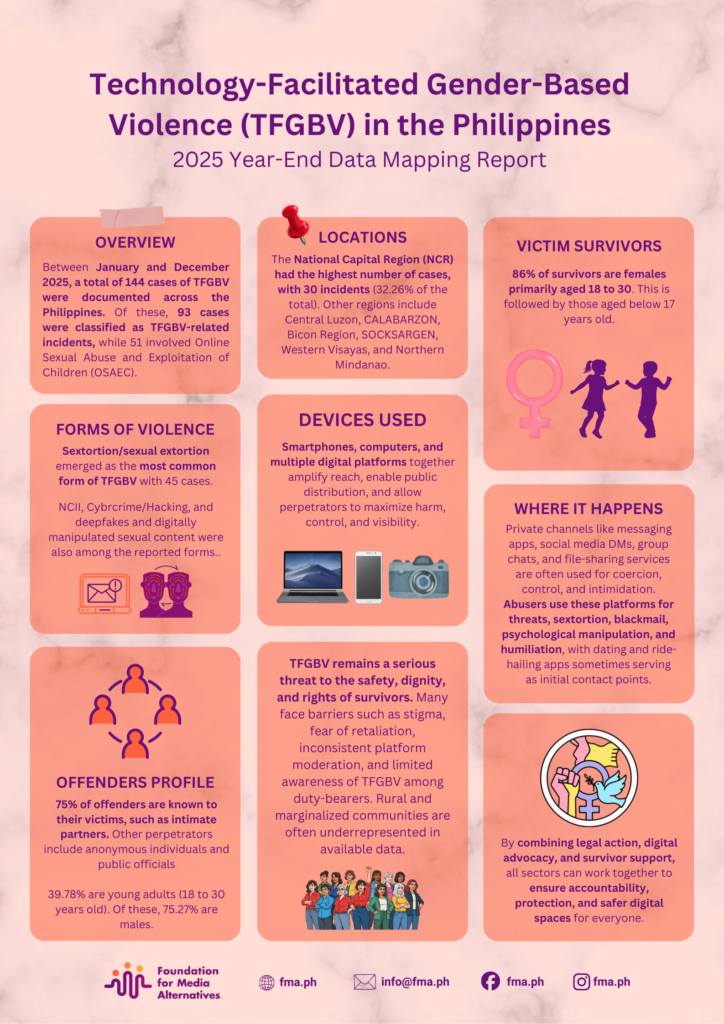
Gender-based violence remains a critical concern in the Philippines, affecting the safety, dignity, and rights of women, girls, and gender-diverse individuals. With the rapid expansion of digital technologies and online platforms, traditional forms of violence have increasingly shifted into virtual spaces, giving rise to a new form of abuse known as technology-facilitated gender-based violence (TFGBV). This encompasses a wide range of harmful behaviors, including online harassment and threats, non-consensual sharing of intimate images, sextortion, and deepfakes, among others.
In this context, data mapping emerges as a vital tool for understanding the prevalence, patterns, and platforms of TFGBV in the Philippines. Between January and December 2025, data were collected from multiple sources, including survivor reports, case records from partner organizations, and online monitoring of news portals and official social media accounts. Cases were categorized using a TFGBV typology adapted to the Philippine context. All information was fully anonymized to protect survivor privacy, and strict ethical safeguards were maintained throughout the process.
The systematic collection and analysis of these data enable stakeholders including government agencies, civil society organizations, and technology platforms to make evidence-based decisions that enhance prevention, strengthen response mechanisms, and hold perpetrators accountable through a survivor-centered approach. Data mapping also helps identify high-risk groups and regions, ensuring that interventions are both targeted and responsive to emerging trends in online abuse, while prioritizing the safety and needs of survivors.
However, the findings are subject to certain limitations. Underreporting is likely due to stigma, fear, and limited awareness of reporting mechanisms, while digital access gaps, particularly in rural or underserved areas, may have restricted the visibility of certain cases. In addition, cases of online sexual abuse and exploitation of children (OSAEC) managed by children’s rights organizations were not included in this year-end report.
Overview of Documented TFGBV Cases in the Philippines
Since 2012 to the present, a total of 829 cases of technology-facilitated gender-based violence (TFGBV) have been mapped in the Philippines. In 2025 alone, between January and December, 144 cases were documented nationwide. These cases were recorded across all major regions, including the National Capital Region (NCR), Luzon, Visayas, Mindanao, the Cordillera Administrative Region (CAR), and the Bangsamoro Autonomous Region in Muslim Mindanao (BARMM), as well as several cases with undisclosed locations.
Of the total cases documented in 2025, 93 were classified as TFGBV-related incidents, while 51 involved Online Sexual Abuse and Exploitation of Children (OSAEC). The geographic spread of these reports highlights the nationwide scope of technology-facilitated abuse and underscores the need for targeted, region-specific prevention, protection, and response mechanisms.
Reports were received consistently throughout the year, with a gradual increase in documented cases over time. The cases involved survivors from diverse demographic backgrounds, reflecting the broad reach of technology-facilitated harm. Throughout the documentation process, strict anonymization and confidentiality protocols were maintained to safeguard the privacy and protection of survivors.
Prevalent Types of Technology-Facilitated Gender-Based Violence in the Philippines
Based on the documented cases, TFGBV in the Philippines most commonly manifests as sexual exploitation, coercion, and control enabled through digital tools. Technology does not just enable abuse but also amplifies it, allowing perpetrators to harm victims across time and space with speed, anonymity, and permanence.
Sextortion or sexual extortion is the most common form, with 45 cases (48.38%). Perpetrators obtain or create intimate images or videos through deception, hacking, coercion, or secret recordings and then use them to threaten victims. Common threats include sharing content with family, friends, employers, or the public, forcing compliance with money, sexual acts, or silence. Many cases involve minors, making them serious violations of child protection and human rights.
Closely related is the non-consensual taking or sharing of intimate images (NCII), reported in 15 cases (16.12%). Survivors were secretly recorded, photographed without consent, or had private content stolen. This material is sometimes shared online or used for blackmail. Even the threat of sharing constitutes a serious violation of privacy and dignity.
Online sexual harassment and public shaming occurred in 35 cases (37.63%), involving humiliating messages, sexualized threats, and harassment campaigns. Some incidents included manipulated videos, causing defamation, reputational harm, and public scrutiny. Women and girls were often targeted with sexualized insults and gendered disinformation.
Other cases involved cyber harassment, cyberstalking, and digital intimidation, often continuing after relationships ended. Perpetrators used digital tools to maintain control, pressure, and instill fear, causing long-term psychological harm even without physical contact.
Online trafficking and commercial sexual exploitation appeared in 10 cases (10.75%), where digital platforms were used to recruit or control victims for prostitution, pornography, or other exploitative purposes. These cases included psychological abuse, threats, and restrictions on movement, highlighting the link between TFGBV and human trafficking.
Emerging forms of abuse, including deepfakes and digitally manipulated sexual content, also appear in the cases. Victims’ likenesses are inserted into explicit material without consent, causing profound emotional distress, reputational damage, and fear for personal safety. These incidents highlight how advancing technologies create increasingly invasive forms of gender-based violence.
Other documented forms include cybercrime, hacking, and identity theft (8 cases, 8.60%), online defamation or reputation harm (5 cases, 22.71%), and sexual violence or physical coercion (5 cases, 22.71%). Across all forms of TFGBV, common impacts include invasion of privacy, psychological trauma, and loss of autonomy. Perpetrators exploit hacking, impersonation, doxxing, unauthorized access to devices, and identity misuse to magnify control and silence victims. The cumulative consequences include fear, shame, trauma, social isolation, and long-term emotional harm.
Taken together, the total cases exceed 100% due to the overlap in abuse types, reflecting the complex and multifaceted nature of technology-facilitated gender-based violence.
Where TFGBV Occurs in the Philippines
From January to December 2025, Technology-Facilitated Gender-Based Violence (TFGBV) was reported across the Philippines, affecting both urban and rural areas. The National Capital Region (NCR) had the highest number of cases, with 30 incidents (32.26% of the total), reflecting its dense population, widespread internet access, and high online activity.
Other regions with notable numbers of cases included Central Luzon (Region III) with 9 cases (9.68%), CALABARZON (Region IV-A) with 8 cases (8.60%), and the Bicol Region (Region V) with 7 cases (7.53%). SOCCSKSARGEN (Region XII) recorded 5 cases (5.38%), while Western Visayas (Region VI) and Northern Mindanao (Region X) each reported 4 cases (4.30%).
Several regions had fewer incidents: the Ilocos Region (Region I), Cagayan Valley (Region II), Central Visayas (Region VII), and Zamboanga Peninsula (Region IX) each had 3 cases (3.23%). Eastern Visayas (Region VIII) and Caraga (Region XIII) reported 2 cases each (2.15%). The Cordillera Administrative Region (CAR), MIMAROPA (Region IV-B), Davao Region (Region XI), and BARMM each recorded 1 case (1.08%). Six cases (6.45%) were reported without a specified location.
This distribution shows that TFGBV occurs nationwide but is most concentrated in highly urbanized and digitally connected areas. The high incidence in regions like the NCR highlights the need for targeted interventions in urban centers, while remote and underserved areas require strengthened reporting and protection mechanisms.
TFGBV Survivors: Stories, Risks, and Realities
Technology-Facilitated Gender-Based Violence (TFGBV) affects people of all ages and backgrounds in the Philippines. Survivors experience harms like online harassment, sextortion, and digital exploitation, often with lasting emotional and social impacts. Understanding who is affected helps design better, survivor-centered support.
This section highlights the profiles of TFGBV survivors and the factors that make some groups more vulnerable.
Profile of TFGBV Survivors: Age and Gender
Among the documented cases, young adults aged 18-30 were the largest group of TFGBV survivors, making up 29% of cases, followed by minors under 17 at 17%. Adults aged 31-45 accounted for 16%, while older adults 46-60 and over 60 represented 5% and 1%, respectively. The ages of 31% of survivors were not disclosed.
Most survivors were female (86%), while males made up 6%, and 8% were of undisclosed gender.
Percentages exceed 100% because some cases involved multiple survivors or overlapping categories. Overall, these findings show that TFGBV disproportionately affects women and young people, underscoring the need for targeted, survivor-centered support and interventions.
Core Harms and Risks Experienced by TFGBV Survivors
TFGBV survivors experience a wide range of harms, often occurring simultaneously. Psychological and emotional harm is the most prevalent, affecting nearly every case and serving as the central impact of TFGBV. Sexual harm and digital including privacy violations frequently co-occur, forming a core triad of harm that defines many incidents.
Reputational and social harms, such as public shaming, defamation, and strained relationships, are common secondary effects. Physical harm, while less frequent, can be severe, especially when threats of violence are involved. Economic and livelihood impacts including extortion, financial loss, or disruption of work also occur but may be underreported. Legal or rights-related harms are present in some cases, while political or public harms are rare but carry significant consequences when they do occur.
Most cases involve multiple, overlapping harms, reflecting the complex and multifaceted nature of TFGBV. Recognizing the range and interplay of these harms is essential for creating survivor-centered responses that address both immediate protection and long-term recovery.
Channels and Platforms Used in Technology-Facilitated Gender-Based Violence
Based on the documented cases, TFGBV occurs across a variety of digital channels, with different platforms serving distinct roles in abuse. Public platforms such as Facebook, Instagram, TikTok, Twitter/X, video-sharing sites, pornographic websites, and open forums are primarily used to punish, humiliate, and spread harm to wider audiences. These platforms can inflict severe reputational, social, and long-term digital damage due to mass distribution, permanence of content, and collective harassment. Public comment sections also contribute to sustained harassment, though typically on a smaller scale.
Private channels including messaging apps, social media direct messages, group chats, and file-sharing services are mostly used for coercion, control, and intimidation. Abusers leverage these channels for threats, sextortion, blackmail, and psychological manipulation. Closed or private groups allow targeted humiliation, while dating and ride-hailing apps often serve as entry points for initial contact with victims.
The most common setup in these cases involves smartphones accessing both public and private platforms, combining personal coercion with public distribution of content. Computers and websites amplify reach and create long-lasting impacts. Most severe cases involve the use of multiple channels, demonstrating how perpetrators exploit digital tools to maximize harm, control, and visibility.
Perpetrators of Technology-Facilitated Gender-Based Violence in the Philippines
The majority of documented Technology-Facilitated Gender-Based Violence (TFGBV) cases in the Philippines involve perpetrators known to the victims, accounting for 75% of cases. Unknown individuals, groups, public officials, and even technology platforms themselves also contribute, though less frequently. Most perpetrators are young adults aged 18-30 (39.78%), and the vast majority are male (75.27%), highlighting the predominance of young men in these offenses.
Intimate partner TFGBV is one of the most common forms of abuse, occurring within current or former relationships where technology is deliberately used to control, intimidate, and harm. Tactics include digital surveillance, persistent online harassment, and threats to share intimate images or videos without consent, allowing abuse to extend beyond physical spaces and maintain power even after the relationship ends.
Young women, particularly students in high school and college, are highly vulnerable. Perpetrators in these settings are often young men known to the victims, and digital platforms are used to harass, coerce, and manipulate. These abuses can lead to severe emotional distress, social isolation, and disruption of education.
Other perpetrators include anonymous individuals and public officials, illustrating that abuse can be compounded when authority or anonymity is misused. Technology platforms themselves can also enable abuse when reporting systems, content moderation, and safety measures are weak, allowing threats, harassment, and non-consensual content to remain online.
TFGBV in the Philippines is shaped by personal relationships, power dynamics, and the digital environment, emphasizing the need for prevention strategies that address both interpersonal abuse and systemic platform vulnerabilities.
How Survivors of Online Harassment and Exploitation Take Action
TFGBV survivors of online harassment and exploitation take decisive steps to protect themselves and seek justice. They report incidents to authorities like the PNP Anti-Cybercrime Group and NBI, provide critical evidence to support investigations, and cooperate in operations that lead to arrests and legal charges. At the same time, they access counseling and social welfare services for safety and emotional recovery, while also advocating for broader awareness and digital protection such as removing harmful content, strengthening privacy, and speaking out publicly or joining campaigns such as Make It Safer Movement (MISMO). Through these coordinated actions, survivors reclaim control, hold perpetrators accountable, and inspire safer online communities.
Category | Actions Taken |
Legal Action / Reporting to Authorities | Filing complaints, pressing charges, participating in entrapment operations, suing for damages |
Cooperation with Law Enforcement | Providing evidence, assisting in investigations, helping identify perpetrators |
Support / Protection Services | Counseling, social welfare assistance, trauma recovery, protection measures |
Digital / Public Advocacy | Takedowns, reporting to platforms, raising awareness, public advocacy campaigns |
Several government agencies, partylist representatives, and women’s organizations have also actively implemented programs to address TFGBV. Their initiatives include public awareness campaigns, legal assistance for survivors, advocacy for stronger cybercrime and GBV laws, and training for local authorities and law enforcement. Women’s groups and advocacy networks also provide counseling, digital safety guidance, and community-based interventions to prevent and respond to online abuse.
Strengthening Responses to Technology-Facilitated Gender-Based Violence
TFGBV remains a serious threat to the safety, dignity, and rights of survivors. Many face barriers such as stigma, fear of retaliation, inconsistent platform moderation, and limited awareness of TFGBV among duty-bearers. Rural and marginalized communities are often underrepresented in available data.
Effective responses require coordinated, survivor-centered action. Governments and local authorities should enforce GBV and cybercrime laws, strengthen protection desks, and integrate TFGBV into local programs. Online platforms must improve responsiveness, preserve evidence, and implement context-sensitive moderation. Civil society can expand support services, raise awareness, and maintain systematic data collection. Future data mapping should broaden geographic and demographic coverage, standardize tools, and strengthen referral pathways. By combining legal action, digital advocacy, and survivor support, all sectors can work together to ensure accountability, protection, and safer digital spaces for everyone.#

0 Comments