The 20th Congress of the Philippines and Its Efforts Against Gender-Based Violence
Published by Foundation for Media Alternatives (FMA) on
The 20th Congress of the Philippines and Its Efforts Against Gender-Based Violence
By: Shreya Menon, Alternatives Intern at FMA
The 20th Congress of the Philippines, which commenced on July 28 2025, has introduced several legislative proposals aimed at addressing gender-based violence (GBV) in both physical and digital spaces.
With the rapid expansion of digital technologies, abuse increasingly occurs online through technology-facilitated gender-based violence (TFGBV), which disproportionately affects women and gender diverse individuals.
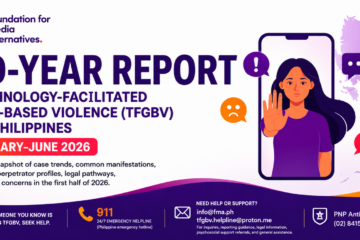
From 2012 to the present, a total of 829 cases of TFGBV have been mapped in the Philippines (FMA, 2026b). To better understand how current legislation responds to these evolving harms, let’s examine key bills introduced in both the Senate and the House of Representatives and how they relate to violence against vulnerable members of the population.
Key Terms
- Technology-Facilitated Gender-Based Violence (TFGBV): refers to any act committed or amplified through digital means that causes physical, sexual, psychological, economic, or social harm (UN Women, 2026).
- Non‑consensual intimate image dissemination: any distribution of an intimate image by means of an information and communications technology system without the consent of the person depicted in the image (United Nations, n.d.).
- Sextortion: a term that merges “sex” and “extortion”, involves the use of threats to share intimate images, videos, or personal information unless the victim complies with demands, which often include sending more explicit content, money, or sexual favors (FMA, 2025).
- Doxxing: to publicly identify or publish private information about (someone), especially as a form of punishment or revenge (Merriam-Webster, 2012).
- Indirect discrimination (SOGIESC): occurs where an apparently neutral condition or requirement is imposed which has the effect of disadvantaging a person of diverse SOGIESC and which is not reasonable in the circumstances (H.B. 5266, 2026, 20th Cong.)
With these concepts in mind, the following section outlines major legislative proposals currently under consideration in the 20th Congress.
LEGAL REFORM BILLS
Senate Bill No. 1892
AMENDMENTS TO THE ANTI-VIOLENCE AGAINST WOMEN AND THEIR CHILDREN ACT
Introduced: February 2026 by Senator Imee R. Marcos
Status: Pending in the Committee on Women, Children, Family Relations and Gender Equality
This bill seeks to amend the Anti-Violence Against Women and Their Children Act of 2004 by extending the time survivors have to file complaints. Furthermore, the new act states that if the abuse was committed by the survivor’s parent, relative, guardian, teacher, boss, or someone in a position of authority, there is no time limit for reporting.
Studies show that many victims of GBV do not report cases to law enforcement. Common reasons includes fear of public and community ridicule, lack of access to support services , anxiety over losing their jobs, seeing other reported cases of GBV not being taken seriously by law enforcement, and many more (Murphy-Oikonen et al., 2020).
Furthermore, survivors of TFGBV often face barriers to reporting, including fear of retaliation, reputational harm, and the permanence of digital content (FMA, 2026a).
By increasing the time in which survivors can report abuse as well as removing time constraints in specific cases, this bill recognizes the long-term and personal effects of GBV (S. 1892, 2026, 20th Cong).
Senate Bill No. 1759
EXPANDED ANTI-VAWC (E-VAWC) ACT
Introduced: February 2026 by Senator Camille A. Villar
Status: Pending in the Committee on Women, Children, Family Relations and Gender Equality
This act also seeks to amend the Anti-Violence Against Women and Their Children Act of 2004 and the penal code to include penalties for perpetrators of online harassment and enable courts to order the removal of harmful digital content and protect the identities of survivors (S. 1759, 2026, 20th Cong).
This is particularly relevant in addressing acts of TFGBV such as doxxing, image-based sexual abuse, sextortion, and persistent online harassment. In 2023, the FMA determined the most common forms and manifestations of TFGBV in the Philippines to be non-consensual production and/or dissemination of intimate images or videos, threats of violence and/or blackmail, and cyber pornography or prostitution.
By enabling faster legal intervention and content takedown, the bill strengthens survivors’ right to digital safety and privacy, while acknowledging that harm inflicted online can escalate very quickly and have extreme consequences.
Senate Bill No. 1890
AMENDMENTS TO THE SAFE SPACES ACT
Introduced: February 2026 by Senator Robinhood Padilla
Status: Pending in the Committee on Women, Children, Family Relations and Gender Equality
This bill aims to strengthen existing laws against sexual harassment by increasing penalties, especially when the perpetrator holds power over the victim in some capacity. If enacted, this bill would increase both the fines and potential jail time for those found guilty of sexual harassment.
The bill makes explicit reference to digital harassment, which can include things like unsolicited sexual messages, stalking via social media, or coordinated abuse campaigns, particularly against women and LGBTQIA+ individuals.
The bill places an emphasis on institutional responsibility for protecting individuals, stating that harassment occurring in workplace and school settings needs to be taken seriously by their respective administrations.
According to studies done on Filipino high school students, online harassment often remains concealed from school authorities due to its covert nature and the reluctance of victims to report incidents (June et al., 2026). This bill would require institutions to implement stronger anti-harassment policies and penalties for offenders and increase security and compensation for survivors. By doing so, students and employees may feel more inclined to file complaints against their abusers.
Furthermore, the bill also suggests the creation of a special fund that would go towards the financial and psychological support of survivors. This fund would be directly sourced from fines paid by offenders of sexual violence (S. 1890, 2026, 20th Cong).
ANTI-DISCRIMINATION BILLS
Senate Bill No. 1341
SOGIE-BASED ANTI-DISCRIMINATION ACT
Introduced: September 2025 by Senator Imee R. Marcos
Status: Pending in the Committee on Women, Children, Family Relations and Gender Equality
This bill seeks to protect individuals from physical and online discrimination based on their sexual orientation or gender identity or expression (SOGIE) using various mechanisms.
One of which is through strong legal penalties for acts of discrimination. The bill aims to penalize those who are found guilty of discrimination against LGBTQIA+ individuals through harsh fines, jail time or both.
Due to intersecting forms of discrimination, LGBTQIA+ individuals are placed in positions of compounded risks of data exploitation and digital surveillance. This, in turn, puts them at greater exposure and risk to coordinated harassment or physical danger (FMA, 2025).
The bill also mandates public education campaigns and institutional reforms, including training for law enforcement and the establishment of protection desks in all police stations, reinforcing the right to equal participation in physical and digital spaces (S. 1341, 2025, 20th Cong).
House Bill No. 5266
ANTI-DISCRIMINATION ACT
Introduced: February 2026 by Representatives Poe, Recto, and Benitez
Status: Pending with the Committee on Women and Gender Equality
This bill contrasts the previously mentioned SOGIE-based discrimination bill by taking a more comprehensive and proactive approach to discrimination against the LGBTQIA+ community. It also expands protections to include sex characteristics (SOGIESC) and introduces the concept of indirect discrimination, where policies that appear neutral can still systematically disadvantage LGBTQIA+ individuals (H.B. 5266, 2026, 20th Cong).
Studies have shown that LGBTQIA+ individuals utilize the internet to seek out spaces for socialization at a greater rate than their heterosexual counterparts. As a result of this greater use of online environments that largely reproduce existing societal biases, LGBTQIA+ individuals are more likely to face greater exposure to TFGBV despite having the same digital rights (Gámez-Guadix & Incera, 2021).
If enacted, this bill would provide LGBTQIA+ individuals with some reassurance that law enforcement, as well as Filipino society, would take a stronger stance to both accept and protect their identities.
INSTITUTIONAL SUPPORT BILLS
House Bill No. 7803
NATIONAL AND LOCAL RESOURCE DEVELOPMENT AND CRISIS CENTRES ACT
Introduced: February 2026 by Representatives Zubiri, De Venecia, Villarica, and Veloso-Tuazon
Status: Pending with the Committee on Women And Gender Equality
This bill seeks to establish both Resource Development and Crisis Centers for women and children in each province and city in the Philippines. These centres would provide temporary shelter as well as access to medical, mental health, legal and referral services.
This bill also mandates the creation of a National Crisis Assistance Centre, which will serve as the model facility for the protection of victims of abuse (H.B. 7803, 2026, 20th Cong).
In cases of both traditional and online GBV, survivors are often unaware of where to seek support and assistance. Furthermore, survivors of TFGBV often require support navigating content removal, digital security, and privacy protection, alongside traditional support services after violence occurs. These centres could play a crucial role in bridging gaps between legal remedies, traditional support, and digital safety support.
Senate Bill No. 1676
WOMEN AND CHILDREN PROTECTION GROUP ACT
Introduced: January 2026 by Senator Bam Aquino
Status: Pending in the Committee of Public Order and Dangerous Drugs
This bill seeks to upgrade the Women and Children Protection Center into a national operational unit with expanded regional reach.
The reform acknowledges that gender-based violence increasingly involves online platforms and transnational networks, requiring more coordinated and technologically equipped law enforcement responses (S. 1676, 2025, 20th Cong).
According to research, now more than ever, perpetrators of violence exploit the borderless and limited regulation nature of the internet to groom, harass, extort, traffic, and violate victims across borders with ease (Equality Now, 2025). As a result, this reform is essential to addressing TFGBV, where perpetrators may operate across jurisdictions and use digital anonymity to evade accountability.
MOVING FORWARD
While the 20th Congress has introduced important legislative measures, gender-based violence across both physical and digital spaces remains a serious challenge in the Philippines.
These bills collectively signal a shift toward recognizing that violence is no longer confined to physical spaces and that legal systems must evolve to address harms mediated by technology.
However, legislation alone is not sufficient; survivors require secure reporting mechanisms, protection of digital privacy and identity, and accessible and comprehensive support.
In a digital age where technology increasingly shapes social interaction, ensuring legal protections against technology-facilitated violence is crucial to uphold the fundamental rights to safety, dignity, and equitable access for all genders.
It is of the utmost importance that individuals, civil society organizations, and other government officials continue to exert pressure on the lawmakers to create a safer and more equitable society for women and gender diverse individuals all across the nation.
Monitor the status of Senate Bills here.
Monitor the status of House Bills here.
References
AN ACT REORGANIZING THE WOMEN AND CHILDREN PROTECTION CENTER (WCPC) OF THE PHILIPPINE NATIONAL POLICE INTO THE WOMEN AND CHILDREN PROTECTION GROUP (WCPG), DEFINING ITS FUNCTIONS, STRUCTURE, AND APPROPRIATING FUNDS THEREFO, no. 1676, Senate (2026). https://legacy.senate.gov.ph/lisdata/4878644737!.pdf
Equality Now. (2025, November 10). End sexual exploitation. Equality Now. https://equalitynow.org/what-we-do/end-sexual-exploitation/
FMA. (2025, July 18). Sextortion in the Philippines: The Hidden Crisis Behind Screens – Foundation for Media Alternatives. Foundation for Media Alternatives. https://fma.ph/sextortion-in-the-philippines-the-hidden-crisis-behind-screens/
FMA. (2026a, January 2). TFGBV in 2026: A New Year, New Digital Threats to Women and Girls – Foundation for Media Alternatives. Foundation for Media Alternatives. https://fma.ph/tfgbv-in-2026-a-new-year-new-digital-threats-to-women-and-girls/
FMA. (2026b, February 27). Technology-Facilitated Gender-Based Violence (TFGBV) in the Philippines Year-End Data Mapping Report – Foundation for Media Alternatives. Foundation for Media Alternatives. https://fma.ph/technology-facilitated-gender-based-violence-tfgbv-in-the-philippines-year-end-data-mapping-report/
Gámez-Guadix, M., & Incera, D. (2021). Homophobia is online: Sexual victimization and risks on the internet and mental health among bisexual, homosexual, pansexual, asexual, and queer adolescents. Computers in Human Behavior, 119, 106728. https://doi.org/10.1016/j.chb.2021.106728
June, Khem, R., Ann, Canggas, A. L., & May, K. (2026). A Case Study on Cyberbullying among Senior High School Students. International Journal of Research and Innovation in Social Science, IX(XII), 3327–3338. https://doi.org/10.47772/ijriss.2025.91200254
AN ACT PROHIBITING DISCRIMINATION, MARGINALIZATION, AND VIOLENCE COMMITTED ON THE BASIS OF SEXUAL ORIENTATION OR GENDER IDENTITY OR EXPRESSION (SOGIE) AND PROVIDING PENALTIES THEREFOR, no. 1341, Senate (2025). https://legacy.senate.gov.ph/lisdata/4800744041!.pdf
AN ACT EXTENDING THE PRESCRIPTIVE PERIOD OF OFFENSES UNDER THE VIOLENCE AGAINST WOMEN AND THEIR CHILDREN ACT, THE CRIME OF RAPE AND THE CRIMES CHARACTERIZED AS CRIMES AGAINST CHASTITY UNDER TITLE ELEVEN OF THE REVISED PENAL CODE, AMENDING FOR THE PURPOSE SECTION TWENTY-FOUR OF REPUBLIC ACT NO. 9262, OTHERWISE KNOWN AS THE “ANTI-VIOLENCE AGAINST WOMEN AND THEIR CHILDREN ACT OF 2004,” AND ARTICLE 90 OF THE REVISED PENAL CODE, AS AMENDED, no. 1892, Senate (2026). https://legacy.senate.gov.ph/lisdata/4917445102!.pdf
Merriam-Webster. (2012). Definition of DOX. Merriam-Webster.com. https://www.merriam-webster.com/dictionary/dox
Murphy-Oikonen, J., McQueen, K., Miller, A., Chambers, L., & Hiebert, A. (2020). Unfounded Sexual Assault: Women’s Experiences of Not Being Believed by the Police. Journal of Interpersonal Violence, 37(11-12). https://doi.org/10.1177/0886260520978190
AN ACT AMENDING REPUBLIC ACT NO. 11313, ENTITLED “AN ACT DEFINING GENDER-BASED SEXUAL HARASSMENT IN STREETS, PUBLIC SPACES, ONLINE, WORKPLACES, AND EDUCATIONAL OR TRAINING INSTITUTIONS, PROVIDING PROTECTIVE MEASURES AND PRESCRIBING PENALTIES THEREFOR” AND FOR OTHER PURPOSES, no. 1890, Senate (2026). https://legacy.senate.gov.ph/lisdata/4917545103!.pdf
AN ACT PROHIBITING DISCRIMINATION ON THE BASIS OF SEXUAL ORIENTATION, GENDER IDENTITY OR EXPRESSION, OR SEX CHARACTERISTICS (SOGIESC) AND PROVIDING PENALTIES THEREFOR, no. 5266, House of Representatives (2025). https://docs.congress.hrep.online/legisdocs/basic_20/HB05266.pdf
UN Women. (2026). Repository of UN Women’s work on technology-facilitated gender-based violence. UN Women – Asia-Pacific. https://asiapacific.unwomen.org/en/digital-library/publications/2024/11/repository-of-un-womens-work-on-technology-facilitated-gender-based-violence
United Nations. (n.d.). Global strategy to prevent and combat non-consensual sharing of intimate images with technology-based solutions. https://www.unodc.org/documents/Cybercrime/global_strategy.pdf?v=4.3
AN ACТ DEFINING ELECTRONIC VIOLENCE AGAINST WOMEN AND THEIR CHILDREN, PROVIDING PROTECTIVE MEASURES, AND PRESCRIBING PENALTIES FOR VIOLATIONS THEREOF, AMENDING FOR THE PURPOSE REPUBLIC ACT NO. 9262, OTHERWISE KNOWN AS THE “ANTI-VIOLENCЕ AGAINST WOMEN AND THEIR CHILDREN ACT OF 2004,” no. 1759, Senate (2026). https://legacy.senate.gov.ph/lisdata/4894444881!.pdf
AN ACT ESTABLISHING A NATIONAL CRISIS ASSISTANCE CENTER (NCAC), AND RESOURCE DEVELOPMENT AND CRISIS CENTERS, FOR WOMEN AND CHILDREN IN EVERY PROVINCE AND CITY IN THE PHILIPPINES, APPROPRIATING FUNDS THEREFOR, AND FOR OTHER PURPOSES, no. 7803, Senate (2026). https://docs.congress.hrep.online/legisdocs/basic_20/HB07803.pdf
About the author:
Shreya Menon, originally from Mississauga, Ontario, Canada, holds an Honours Specialization Degree in Political Science and a Minor in Media Studies from Western University. She is an advocate for finding holistic solutions to global issues, specifically those that disproportionately affect the Global South. In pursuit of opportunities that align with her passions, she joined Global Affairs Canada’s International Youth Internship Program through Alternatives Montreal, which placed her as an intern in the Gender and ICT program at Foundations for Media Alternatives in Quezon City.

0 Comments