Regulating Risk: The 20th Congress of the Philippines Response to Artificial Intelligence
Published by Foundation for Media Alternatives (FMA) on
Regulating Risk: The 20th Congress of the Philippines Response to Artificial Intelligence
By: Shreya Menon, Alternatives Intern
Artificial intelligence (AI), though existing for decades, has undoubtedly changed the world we live in over the past few years.
Although this newfound technology has brought innovation and accessibility across many fields, it has also brought with it a plethora of concerns.
One of these concerns is the new kind of technology-facilitated gender based violence (TFGBV), which AI systems have proliferated. Instances of such violence have been seen across various sectors, such as exploitation, fraud, and the creation of fake pornographic imagery. This practice, commonly known as creating “deepfakes,” has been used in various instances to produce explicit content of individuals without their consent.
In the Philippines, this was seen firsthand with many female celebrities falling victim to sexually explicit deepfakes. In the past year, actress Angel Aquino testified before the Senate of the Philippines to advocate for stricter laws regarding such technology after deepfakes depicting her in a pornographic manner were circulated across the internet without her consent.
Although various laws are in place to protect Filipinos from cybercrimes, the unique concerns AI systems have introduced have called for new and specific legislation to protect citizens. As a result, the 20th Congress of the Philippines, which commenced on July 28, 2025, has introduced various legislation to reduce the harmful effects of AI.
While many pieces of legislation have been put forward, let’s take a look at the bills that are especially helpful in protecting against TFGBV.
KEY TERMS
Artificial Intelligence: the ability of a digital computer or computer-controlled robot to perform tasks commonly associated with intelligent beings. The term is frequently applied to the project of developing systems endowed with the intellectual processes characteristic of humans, such as the ability to reason, discover meaning, generalize, or learn from past experience (Copeland, 2024).
Algorithmic discrimination: occurs when systematic errors in machine learning algorithms produce unfair or discriminatory outcomes. It often reflects or reinforces existing socioeconomic, racial and gender biases (Jonker and Rogers, 2024).
Deepfake: an image or recording that has been convincingly altered and manipulated to misrepresent someone as doing or saying something that was not actually done or said (Merriam-Webster, 2024)
Technology-Facilitated Gender-Based Violence (TFGBV): refers to any act committed or amplified through digital means that causes physical, sexual, psychological, economic, or social harm (UN Women, 2026).
DEEPFAKE REGULATION
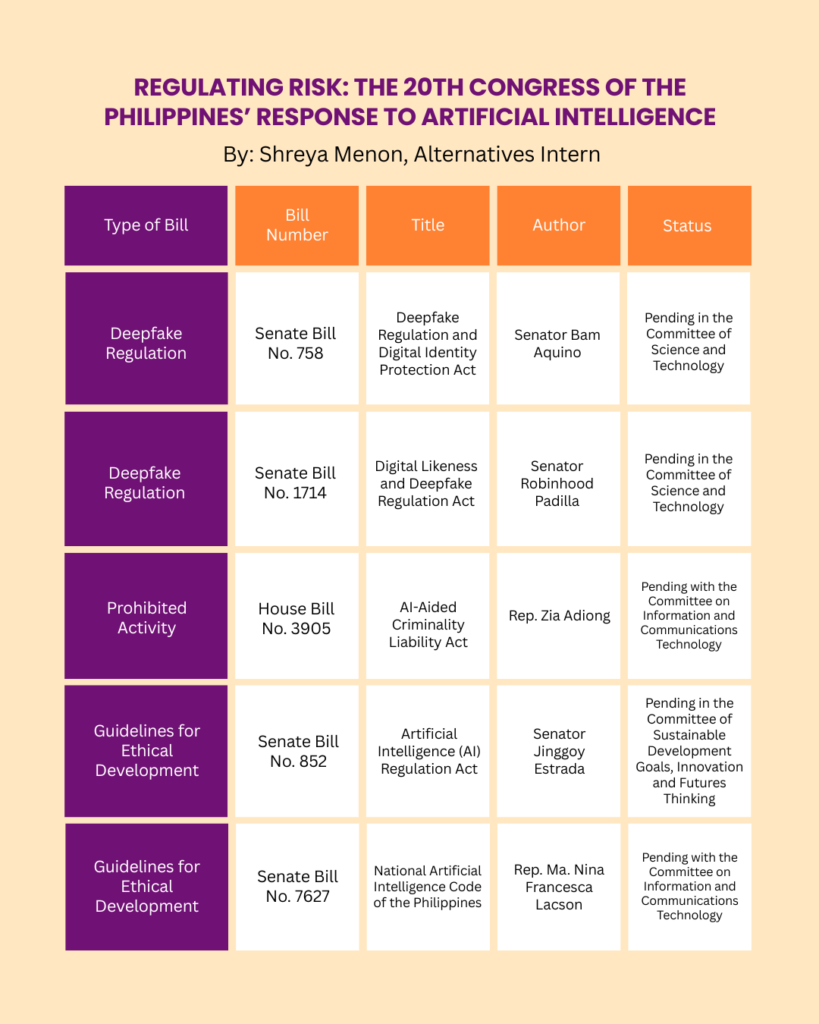
Senate Bill. No. 758
DEEPFAKE REGULATION AND DIGITAL IDENTITY PROTECTION ACT
Introduced: August 2025 by Senator Bam Aquino
Status: Pending in the Committee of Science and Technology
This bill proposes legal frameworks to regulate the creation and use of deepfakes. It establishes that a person has exclusive control over their image, voice, and identity, and treats unauthorized deepfakes as a violation of privacy and dignity. The bill also gives victims of deepfakes the right to receive compensation for emotional and reputational damage.
In terms of content itself, the bill mandates that accounts must clearly disclose when content is AI-generated, and those who fail to do so will be subjected to fines. Furthermore, it would force all digital platforms to remove harmful material within 24 hours if a verified complaint is made (S. 758, 2025, 20th Cong).
According to estimates, over 90 percent of all deepfake videos online are related to non-consensual deepfake pornography (Adjer et al, 2019). Furthermore, 99% of all victims of deepfake pornography identify as women (Romero-Moreno, 2025), making it an issue that deeply proliferates TFGBV.
If implemented, this bill would take significant strides to address the harms that the widespread use of AI can inflict on women and other marginalized groups. By centring consent and giving victims the ability to take down content and seek compensation, the bill directly responds to the ways AI is being used to exploit vulnerable individuals.
Senate Bill No. 1714
DIGITAL LIKENESS AND DEEPFAKE REGULATION ACT
Introduced: January 2026 by Senator Robinhood Padilla
Status: Pending in the Committee of Science and Technology
This bill shares several similarities with the above-mentioned Senate Bill No. 758, but takes a broader approach. If enacted, this bill would grant individuals all the legal protections of Bill No. 758 and extend protections to include commercial exploitation, fraud, and threats to democratic processes.
As a result, this bill would enforce deeper consequences if someone were to use another individual’s identity in a fake ad to sell products, impersonate them for money, or create fake videos that could mislead voters. Furthermore, the maximum fines for those found guilty of creating non-consensual deepfakes would be heavier than the ones listed in Bill No. 758
In the context of TFGBV, this expanded scope is significant because it recognizes how gendered abuse can operate beyond the personal level but within public and political spaces (S. 1714, 2026, 20th Cong), where women are disproportionately subjected to disinformation, sexualized deepfakes, and coordinated harassment campaigns.
According to the UN, female leaders, journalists, activists, and public figures face relentless gendered disinformation, deepfake attacks, and coordinated harassment campaigns (Carmo, 2025).
By addressing both private harms and systemic risks, the bill offers a more comprehensive framework for addressing AI-enabled gender-based violence.
PROHIBITED ACTIVITY
AI-Aided Criminality Liability Act
Introduced: August 2025 by Representative ZIAUR-RAHMAN “ZIA” ALONTO ADIONG
Status: Pending with the Committee on INFORMATION AND COMMUNICATIONS TECHNOLOGY
This bill seeks to strengthen the penal code to recognize the effect of AI as an aggravating factor in crimes.
If enacted, instances in which AI is used to facilitate or enhance the crime would be increased by one degree. The purpose of this bill is to ensure that technological tools cannot be used to evade accountability and are instead treated as amplifiers of harm.
Furthermore, it mandates that corporations that knowingly or negligently allow their AI systems to be used for criminal activity will be held liable. As a result, it forces companies to incorporate safeguards into their frameworks, challenging the idea that the producers of such technology cannot be held accountable for the harm their products cause.
In terms of reducing TFGBV, the bill provides indirect but meaningful protection by increasing penalties for crimes relating to TFGBV, such as harassment, fraud, defamation, sextortion, etc. This is particularly relevant for cases like non-consensual sexual deepfakes or impersonation that disproportionately affect women and gender diverse individuals.
Additionally, by holding corporations liable for enabling criminal use of AI, the bill shifts some responsibility onto tech companies, which in turn can create stronger safeguards in their products to protect against TFGBV from occurring (H.B. 3905, 2026, 20th Cong).
GUIDELINES FOR ETHICAL DEVELOPMENT
ARTIFICIAL INTELLIGENCE (AI) REGULATION ACT
Introduced: August 2025 by Senator Jinggoy Ejercito Estrada
Status: Pending in the Committee of Sustainable Development Goals, Innovation and Futures Thinking
This bill seeks to prevent potential safety threats of AI by taking a proactive approach to regulating the development of AI.
The bill mandates the creation of a Philippine Council on Artificial Intelligence to evaluate the development and impact of AI systems. This council would be tasked with creating rules to prevent harmful applications of AI, as well as enforcing an “AI Bill of Rights” that would guarantee individuals better protections from harmful AI, privacy violations, algorithmic discrimination and more. Furthermore, the bill specifically prohibits artificial intellegence to discriminate based on sex, gender identity, socioeconomic status, and other marginalized identities (S. 852, 2025, 20th Cong).
As they currently exist, AI systems can reinforce stereotypes and inflict biases and violence against women and girls. Furthermore, male developers and leaders in the AI sector severely outnumber their female counterparts, leading to an overall lack of female perspective in the development of such systems (UNESCO, 2024).
By including stronger oversight and proactivity in the development of AI systems to reduce biases that harm women and other marginalized groups, this bill can attempt to lessen the proliferation of TFGBV at the foundational level.
NATIONAL ARTIFICIAL INTELLIGENCE CODE OF THE PHILIPPINES
Introduced: February 2026 by Representative Ma. Nina Francesca P. Lacson
Status: Pending with the Committee on INFORMATION AND COMMUNICATIONS TECHNOLOGY
This bill, like Senate Bill No. 852, also seeks to prevent potential safety threats of AI by taking a proactive approach to regulating the development of AI and through strong legal frameworks.
If enacted, this bill would mandate the creation of the Bureau of Artificial Intelligence Systems (BAIS). This regulatory body would be tasked with classifying high-risk AI, enforcing compliance, and issuing penalties for developers. Furthermore, like Senate Bill No 852, this bill would establish a “Bill of Rights” that guarantees protections against harmful and discriminatory AI systems.
The bill also mandates that systems and platforms must disclose when AI is involved in decision-making, and prohibits harmful practices like deceptive AI, exploitation of vulnerable groups, and unauthorized impersonation (H.B. 7627, 2026, 20th Cong).
Although indirect, this bill can offer improved protection against TFBGV by targeting the underlying technologies and practices that can enable it. By banning deceptive and exploitative AI systems, the bill can help prevent harms like deepfake abuse and online harassment. Furthermore, strong consent and data protection can help address the non-consensual use of personal images or data.
MOVING FORWARD
While the 20th Congress has introduced important legislation to combat the harms associated with artificial intelligence, TFGBV, through the use of AI, is still a prevalent issue across the Philippines.
Although the desired outcome of each bill varies, each one showcases the reality that AI is a unique and complex technology that requires specific parameters for safe utilization – especially for women and gender diverse individuals.
In a digital age where technology is embedded into our daily lives, ensuring legal protections against technology-facilitated violence is crucial to uphold the fundamental rights to safety, dignity, and equitable access for all genders.
It is of the utmost importance that individuals, civil society organizations, and other government officials continue to exert pressure on lawmakers to ensure that harm and discriminatory practices are significantly reduced from AI systems.
Monitor the status of Senate Bills here.
Monitor the status of House Bills here.
References
Adjer, H., Patrini, G., Cavalli, F., & Cullen, L. (2019). The State of Deepfakes: Landscape, Threats, and Impact, Henry Ajder, Giorgio Patrini, Francesco Cavalli, and Laurence Cullen, September 2019. Docslib. https://docslib.org/doc/12559428/the-state-of-deepfakes-landscape-threats-and-impact-henry-ajder-giorgio-patrini-francesco-cavalli-and-laurence-cullen-september-2019
AN ACT RECOGNIZING THE USE OF ARTIFICIAL INTELLIGENCE AND GENERATIVE TECHNOLOGIES IN THE COMMISSION OF A CRIME AS AN AGGRAVATING CIRCUMSTANCE, AND PROVIDING FOR THE LIABILITY OF DEVELOPERS AND PLATFORMS THEREOF, no. 3905, House of Representatives (2025). https://docs.congress.hrep.online/legisdocs/basic_20/HB03905.pdf
Carmo, A. (2025, November 20). AI and anonymity fuel surge in digital violence against women. UN News. https://news.un.org/en/story/2025/11/1166411
Copeland, B. J. (2024). Artificial intelligence. In Encyclopedia Britannica. https://www.britannica.com/technology/artificial-intelligence
AN ACT ESTABLISHING A REGULATORY FRAMEWORK FOR A ROBUST, RELIABLE, AND TRUSTWORTHY DEVELOPMENT, APPLICATION, AND USE OF ARTIFICAL INTELLIGENCE (AI) SYSTEMS, CREATING THE PHILIPPINE COUNCIL ON ARTIFICIAL INTELLIGENCE, DELINEATING THE ROLES OF VARIOUS GOVERNMENT AGENCIES, DEFINING AND PENALIZING CERTAIN PROHIBITED ACTS, no. 852, Senate (2025). https://legacy.senate.gov.ph/lisdata/4741843421!.pdf
Jonker, A., & Rogers, J. (2024, September 20). What Is Algorithmic bias? IBM; IBM. https://www.ibm.com/think/topics/algorithmic-bias
AN ACT INSTITUTING THE NATIONAL ARTIFICIAL INTELLIGENCE CODE OF THE PHILIPPINES, CREATING THE BUREAU OF ARTIFICIAL INTELLIGENCE SYSTEMS UNDER THE DEPARTMENT OF INFORMATION AND COMMUNICATIONS TECHNOLOGY, AND ESTABLISHING A COMPREHENSIVE FRAMEWORK FOR THE SAFE, ETHICAL, AND INCLUSIVE GOVERNANCE OF ARTIFICIAL INTELLIGENCE SYSTEMS IN THE COUNTRY, AND FOR OTHER PURPOSES, no. 7627, House of Representatives (2026). https://docs.congress.hrep.online/legisdocs/basic_20/HB07627.pdf
Merriam-Webster. (2024). Definition of DEEPFAKE. Www.merriam-Webster.com. https://www.merriam-webster.com/dictionary/deepfake
AN ACT SAFEGUARDING INDIVIDUAL LIKENESS, IDENTITY, AND PUBLICITY RIGHTS BY REGULATING THE CREATION AND USE OF DEEPFAKES THROUGH DISCLOSURE, CONSENT, AND PLATFORM ACCOUNTABILITY, AND PROVIDING REMEDIES AND PENALTIES THEREFOR, AND FOR OTHER PURPOSES, no. 1714, Senate (2026). https://senate.gov.ph/legacy/lis_bills/4886444808!.pdf
Romero-Moreno, F. (2025). Deepfake detection in generative AI: A legal framework proposal to protect human rights. Computer Law & Security Review, 58(106162), 106162–106162. https://doi.org/10.1016/j.clsr.2025.106162
UN Women. (2026). Repository of UN Women’s work on technology-facilitated gender-based violence. UN Women – Asia-Pacific. https://asiapacific.unwomen.org/en/digital-library/publications/2024/11/repository-of-un-womens-work-on-technology-facilitated-gender-based-violence
UNESCO. (2024). Challenging Systematic prejudices: an Investigation into Bias against Women and Girls in Large Language Models. Unesco.org. https://unesdoc.unesco.org/ark:/48223/pf0000388971
About the author:
Shreya Menon, originally from Mississauga, Ontario, Canada, holds an Honours Specialization Degree in Political Science and a Minor in Media Studies from Western University. She is an advocate for finding holistic solutions to global issues, specifically those that disproportionately affect the Global South. In pursuit of opportunities that align with her passions, she joined Global Affairs Canada’s International Youth Internship Program through Alternatives Montreal, which placed her as an intern in the Gender and ICT program at Foundations for Media Alternatives in Quezon City.


0 Comments