Mid-Year Report on Technology-Facilitated Gender-Based Violence (TFGBV) in the Philippines (January–June 2026)
Published by Foundation for Media Alternatives (FMA) on
Mid-Year Report on Technology-Facilitated Gender-Based Violence (TFGBV) in the Philippines (January–June 2026)
Technology-Facilitated Gender-Based Violence (TFGBV) remains a significant concern in the Philippines as digital technologies and online platforms continue to be used to facilitate harassment, sexual exploitation, abuse, and other forms of gender-based harm.
From January to June 2026, documented TFGBV cases involved various forms of online abuse, including online sexual exploitation of children (OSAEC), image-based sexual abuse, sextortion, cyber harassment, trafficking-related offenses, and other technology-enabled forms of violence. This mid-year report presents findings from FMA’s TFGBV Mapping, highlighting case trends, common manifestations, survivor and perpetrator profiles, legal pathways, and emerging concerns identified during the first half of 2026.
Overview of Documented Cases
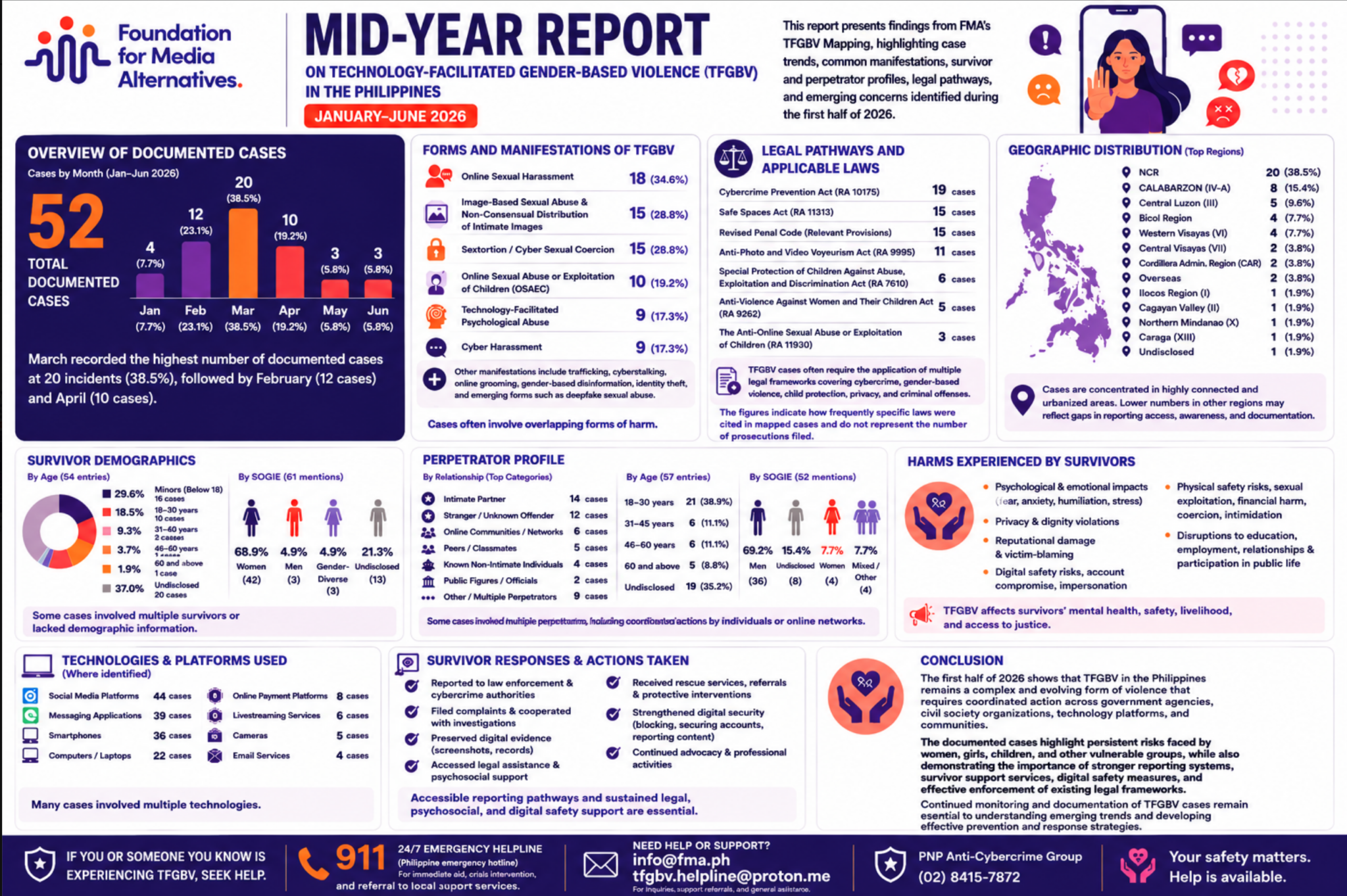
Since 2012, FMA’s TFGBV Mapping has documented 881 cases of technology-facilitated gender-based violence (TFGBV) in the Philippines. For January – June 2026 alone, 52 cases were documented, with reported incidents increasing during the first months of the year. March recorded the highest number of cases at 20 (38.5%), followed by February with 12 cases (23.1%) and April with 10 cases (19.2%).
The documented cases reflected persistent and evolving forms of technology-facilitated violence, including online sexual harassment, image-based abuse, sextortion, cyber harassment, online exploitation, and trafficking-related offenses. The reporting period also showed emerging concerns involving deepfake-enabled abuse, cyber-enabled exploitation, cross-border networks, and increasingly complex investigations.
Although documented cases declined in the succeeding months, this should not be interpreted as a decrease in the prevalence of TFGBV. Case numbers may be affected by reporting patterns, investigation timelines, validation processes, and survivors’ access to reporting and support mechanisms.
Forms and Manifestations of TFGBV
The most frequently documented forms of TFGBV were online sexual harassment (18 cases or 34.6%), image-based sexual abuse and non-consensual distribution of intimate images (15 cases or 28.8%), and sextortion or cyber sexual coercion (15 cases or 28.8%).
Other documented forms included online sexual abuse or exploitation of children (10 cases or 19.2%), technology-facilitated psychological abuse (9 cases or 17.3%), and cyber harassment (9 cases or 17.3%). Additional manifestations included trafficking, cyberstalking, online grooming, gender-based disinformation, identity theft, and emerging forms such as deepfake sexual abuse.
The findings show that TFGBV cases often involve overlapping forms of harm. A single incident may include sexual exploitation, harassment, coercion, privacy violations, and psychological abuse. The reported frequencies represent recurring manifestations and are not mutually exclusive; therefore, they should not be added together to determine the total number of cases.
Legal Pathways and Applicable Laws
TFGBV cases documented during the reporting period involved multiple legal frameworks, reflecting the complex nature of technology-enabled violence. The figures indicate how frequently specific laws were cited in mapped cases and do not represent the number of prosecutions filed.
The Cybercrime Prevention Act (RA 10175) was the most frequently cited law, appearing in 19 cases involving cyber harassment, sextortion, image-based abuse, and online exploitation. The Safe Spaces Act (RA 11313) and relevant provisions of the Revised Penal Code each appeared in 15 cases involving online sexual harassment, threats, coercion, and related offenses.
The Anti-Photo and Video Voyeurism Act (RA 9995) was cited in 11 cases involving the unauthorized sharing of intimate images and videos. Child protection laws were also applied, with RA 7610 cited in six cases and RA 11930 in three cases involving child sexual abuse and online exploitation. RA 9262 was cited in five cases involving intimate partner violence and technology-enabled abuse.
Overall, the mapping demonstrates that TFGBV cases often require the application of multiple legal frameworks covering cybercrime, gender-based violence, child protection, privacy, and criminal offenses.
Geographic Distribution
The TFGBV Mapping documented cases across multiple regions, with the highest concentration recorded in highly connected and urbanized areas.
The National Capital Region (NCR) recorded the highest number of cases with 20 incidents (38.5%), followed by CALABARZON (Region IV-A) with eight cases (15.4%) and Central Luzon (Region III) with five cases (9.6%). Together, these regions accounted for 63.5% of all documented cases.
Other recorded cases came from Bicol Region and Western Visayas with four cases each, Central Visayas, the Cordillera Administrative Region (CAR), and overseas cases with two cases each, and Ilocos Region, Cagayan Valley, Northern Mindanao, and Caraga with one case each. One case did not disclose location information.
The geographic distribution suggests that documented TFGBV cases are concentrated in areas with greater connectivity, reporting mechanisms, and institutional presence. However, lower numbers in other regions may reflect gaps in reporting access, awareness, and documentation rather than lower incidence.
Survivor Demographics
The mapping recorded 54 survivor age entries and 61 SOGIE (sexual orientation, gender identity, and expression) mentions. Some cases involved multiple survivors or lacked demographic information.
Minors represented the largest identified age group, with 16 cases (29.6%), reflecting the continued vulnerability of children to online sexual exploitation, grooming, and other forms of digital abuse. Survivors aged 18–30 accounted for 10 cases (18.5%), commonly involving image-based abuse, sextortion, cyber harassment, and technology-facilitated intimate partner violence.
Other identified age groups included survivors aged 31 – 45 (five cases or 9.3%), 46 – 60 (two cases or 3.7%), and 60 and above (one case or 1.9%). Twenty entries (37.0%) did not disclose survivor age.
Women comprised the majority of recorded survivor SOGIE mentions, with 42 entries (68.9%). Undisclosed SOGIE information accounted for 13 mentions (21.3%), while men and gender-diverse persons each accounted for three mentions (4.9%).
The findings reaffirm that women and girls remain disproportionately affected in documented TFGBV cases while emphasizing the need for more consistent and inclusive survivor demographic documentation.
Perpetrator Profile
Intimate partners were the most frequently identified perpetrators, appearing in 14 cases involving image-based abuse, sextortion, and coercive control. Strangers or unknown offenders followed with 12 cases, reflecting the role of anonymity in cyber harassment, cyberstalking, and other online offenses.
Other identified perpetrators included online communities, peers or classmates, known non-intimate individuals, and public figures or officials. Some cases involved multiple perpetrators, including coordinated actions by individuals or online networks.
Among documented perpetrator ages, individuals aged 18–30 comprised the largest identified group with 21 entries (38.9%), followed by those aged 31–45 and 46–60 with six entries each. Nineteen cases (35.2%) did not disclose perpetrator age.
Men accounted for the majority of documented perpetrator SOGIE mentions, with 36 entries (69.2%). Eight entries (15.4%) did not disclose SOGIE information, while women and mixed-gender groups represented smaller proportions.
These findings highlight the continued role of intimate partners, male offenders, anonymous actors, and online networks in perpetrating TFGBV.
Harms Experienced by Survivors
TFGBV survivors experienced multiple and overlapping forms of harm. Psychological and emotional impacts were the most frequently documented, including fear, anxiety, trauma, humiliation, stress, and emotional distress.
Other harms included privacy and dignity violations caused by unauthorized sharing of intimate images and personal information, reputational damage, victim-blaming, digital safety risks, account compromise, impersonation, and persistent online harassment.
Some cases also involved physical safety risks, sexual exploitation, financial harm, coercion, and intimidation, particularly in sextortion, trafficking, and OSAEC cases. Survivors also experienced disruptions to education, employment, relationships, and participation in public life.
The findings demonstrate that TFGBV extends beyond online spaces and affects survivors’ mental health, safety, livelihood, and access to justice. Effective responses require legal assistance, psychosocial support, digital security interventions, and long-term survivor-centered services.
Technologies and Platforms Used
Digital platforms and devices remained central to the facilitation of TFGBV during the reporting period. Because many cases involved multiple technologies, figures represent cases where a platform or device was identified rather than separate incidents.
Social media platforms were identified in 44 cases involving harassment, recruitment, sextortion, dissemination of intimate images, and communication with survivors. Messaging applications appeared in 39 cases, commonly used for threats, coercion, extortion, and communication between perpetrators and victims.
Smartphones were involved in 36 cases, primarily for recording, storing, sharing, and accessing
abusive content. Computers and laptops appeared in 22 cases, particularly in OSAEC, livestreaming, and digital account management cases.
Other identified technologies included online payment platforms, livestreaming services, cameras, and email services. The findings emphasize the importance of stronger digital evidence documentation, platform accountability, and digital safety education.
Survivor Responses and Actions Taken
Survivors took various actions in response to TFGBV incidents, including reporting cases to law enforcement and cybercrime authorities, filing complaints, cooperating with investigations, and preserving digital evidence such as screenshots and online records.
Many survivors accessed legal assistance, psychosocial support, rescue services, and protective interventions. Child survivors were often supported by parents, guardians, social workers, and authorities through rescue operations, referrals, counseling, and legal processes.
Some survivors strengthened their digital security by blocking perpetrators, securing accounts, and reporting abusive content. Journalists, human rights defenders, and public figures also used formal reporting mechanisms while continuing advocacy and professional activities despite online attacks.
The findings highlight the importance of accessible reporting pathways and sustained legal, psychosocial, and digital safety support.
Online Sexual Abuse or Exploitation of Children (OSAEC)
The 29 OSAEC-related cases documented from January to June 2026 are part of FMA’s separate OSAEC mapping initiative and are not included in the broader TFGBV Mapping. The mapping tracks trends and patterns in online child sexual exploitation and abuse, including child sexual abuse materials, online grooming, livestreamed exploitation, technology-facilitated trafficking, coercion, and sextortion. Cases also reflect the use of digital platforms and, in some instances, organized or cross-border networks.
FMA does not directly investigate or manage OSAEC cases. Cases involving children are referred to specialized child protection organizations and relevant government agencies for appropriate, survivor-centered support. The findings underscore the need for stronger prevention, digital safety education, specialized child protection services, coordinated responses, and international cooperation.
Conclusion
The first half of 2026 shows that TFGBV in the Philippines remains a complex and evolving form of violence that requires coordinated action across government agencies, civil society organizations, technology platforms, and communities.
The documented cases highlight persistent risks faced by women, girls, children, and other vulnerable groups, while also demonstrating the importance of stronger reporting systems, survivor support services, digital safety measures, and effective enforcement of existing legal frameworks.
Continued monitoring and documentation of TFGBV cases remain essential to understanding emerging trends and developing effective prevention and response strategies.#


0 Comments