Who Bears the Cost? Mapping the Impacts of AI in the Philippines
Published by Foundation for Media Alternatives (FMA) on
Who Bears the Cost? Mapping the Impacts of AI in the Philippines
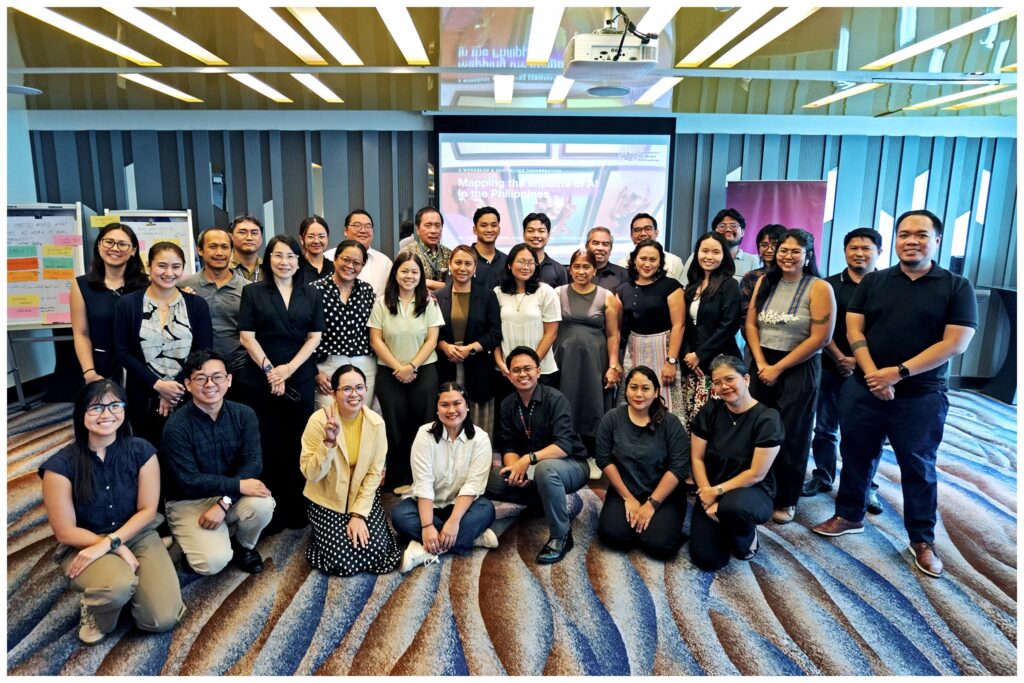
Last July 28, 2026, the Foundation for Media Alternatives (FMA), together with Fair Transition Lab, held “Mapping the Impacts of AI in the Philippines: A Civil Society Risk-Mapping Workshop,” bringing together civil society and grassroots representatives to identify and examine the risks emerging from the rapid adoption of artificial intelligence across different sectors.
The workshop gathered participants from the academe, civil society organizations, research institutions, media, legal practice, the BPO industry, and the digital rights advocacy community. Through discussions and sectoral risk-mapping exercises, participants surfaced concerns specific to their fields, highlighting how the growing use of AI can affect workers, communities, public institutions, and fundamental rights.
These concerns become increasingly urgent as the Philippines positions itself within the expanding global AI ecosystem. Initiatives such as Pax Silica, which seek to strengthen semiconductor production, AI infrastructure, and critical technology supply chains, demonstrate how the country is becoming more deeply integrated into the global AI economy. At the same time, the rapid deployment of AI technologies—from automated decision-making systems to generative AI and large-scale data centers—raises questions about who benefits from these developments and who bears their social, economic, environmental, and human rights costs.
For the Philippines, understanding these impacts cannot be separated from questions of labor, energy, data governance, privacy, inequality, environmental sustainability, and technological sovereignty. As AI development accelerates, communities and sectors most affected by these technologies must have a meaningful role in determining how they are developed and deployed.
The workshop underscores the need for more spaces for collective risk assessment and dialogue. Civil society-led consultations can help identify emerging harms that may otherwise be overlooked and translate lived experiences into concrete policy recommendations.
Workshop outputs will feed directly into a risk-mapping paper that will undergo a collaborative drafting/validation process after this event. But we emphasize the need for continued workshops, research, and multi-sectoral discussions to ensure that AI policies in the Philippines are grounded not only in technological advancement and economic growth, but also in human rights, public accountability, and the needs of affected communities.
As the country takes part in the global race for AI and advanced technologies, it must also ask a fundamental question: What kind of technological future are we building, and who gets to shape it?


0 Comments